Rohan Paul (@rohanpaul_ai)
2024-11-16 | ❤️ 417 | 🔁 79
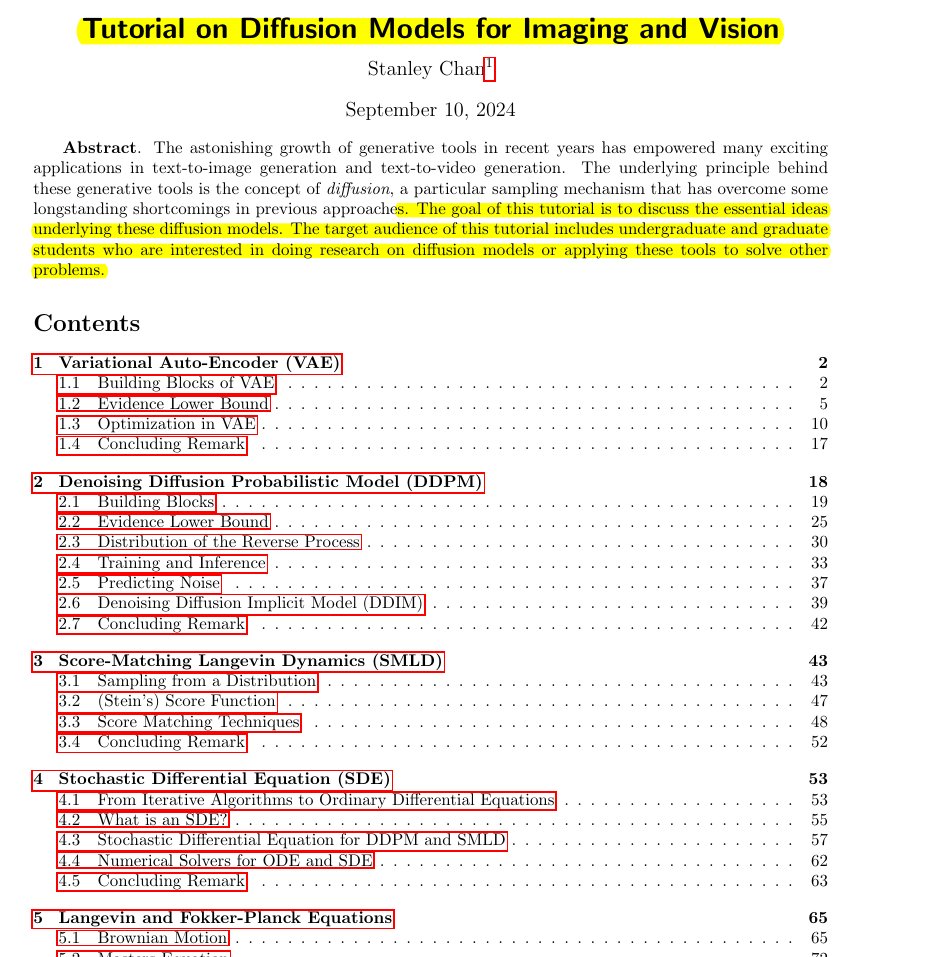
🎯 A deep mathematical exploration of diffusion models for modern AI image generation.
Discusses all the essential ideas underlying these diffusion models.
Provides a comprehensive mathematical foundation for understanding diffusion models, covering key concepts from Variational Autoencoders (VAE) to Stochastic Differential Equations (SDE).
It systematically explains how denoising diffusion probabilistic models (DDPM) and score-matching Langevin dynamics (SMLD) evolved from VAE concepts, while providing rigorous mathematical proofs and intuitive explanations of the underlying physics principles like Brownian motion and Fokker-Planck equations. The paper bridges the gap between modern diffusion AI techniques and classical statistical physics, making complex concepts accessible through clear derivations and practical examples.
→ The mathematical foundations of diffusion models and their connection to physics
VAE acts as building block by showing how to convert between latent and data distributions. DDPM extends this by breaking down the conversion into many small steps through forward and reverse diffusion processes.
→ The relationship between DDPM and SMLD approaches
Both methods can be unified through the lens of stochastic differential equations - DDPM uses variance preserving SDE while SMLD uses variance exploding SDE. Their inference processes are mathematically equivalent.
→ The physical interpretation of diffusion through Langevin equations
Langevin equations describe Brownian motion and provide mathematical framework for understanding how particles diffuse. The Fokker-Planck equation gives probabilistic description of the diffusion process.
→ The key innovations that enabled practical diffusion models
Reparameterization trick, score matching loss functions, and numerical SDE solvers were critical developments. The prediction-correction algorithm helps improve sampling efficiency.
미디어